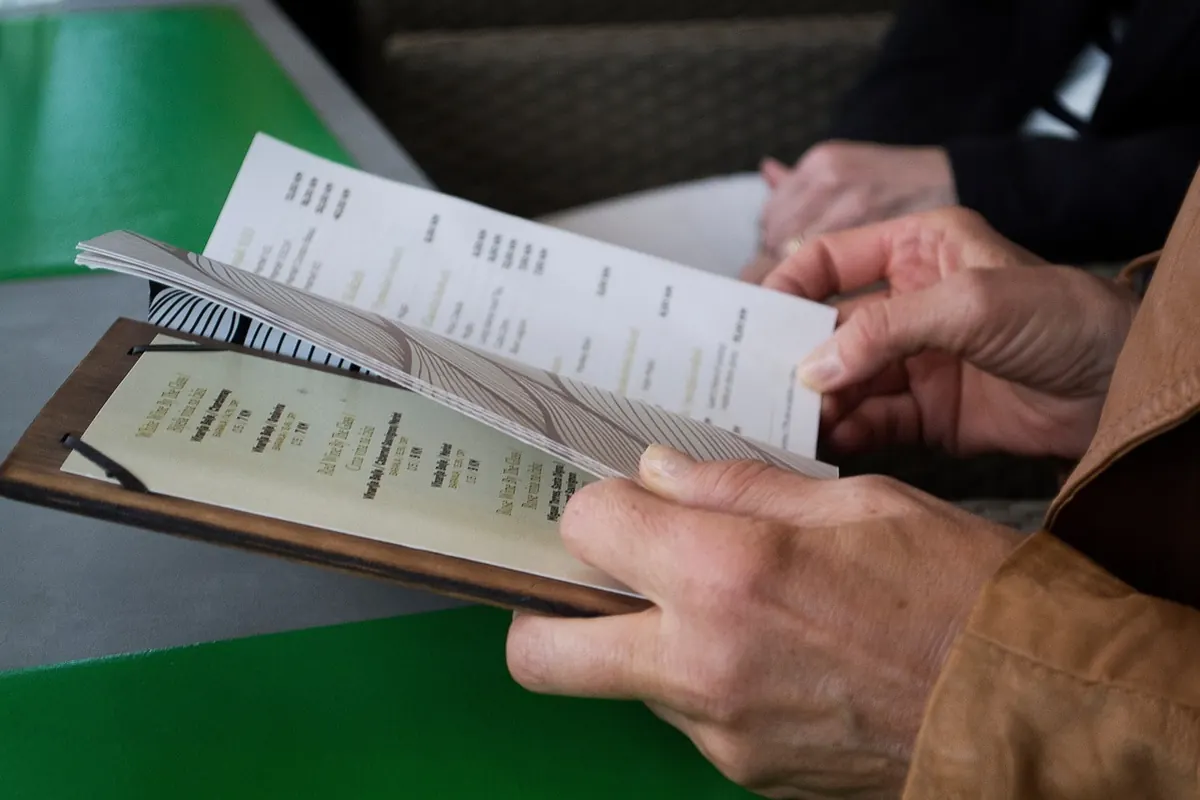
A menu lands on the table, plastic-sleeved and dense with words you half-recognise, and everyone turns to you — the one who is supposed to be good at this. It is a small, specific panic, and it has little to do with how well you speak the language. Menus are not written for travellers. They are written for people who already know the local rhythm of eating: which plates are starters, which arrive as a side, which are meant for the middle of the table, which come in a portion the size of a thumbnail. Learning to read that rhythm takes an afternoon, not a language course.
Almost every menu is organised by a local logic, and that logic will help you before any dictionary does. In Italy a full menu runs antipasti, primi (pasta, risotto, soup), secondi (meat or fish), contorni (vegetables, ordered and priced separately) and dolci. Knowing the sequence prevents the classic first-night mistake: ordering a primo and a secondo for one person and watching two full plates arrive at once.
In France, an entrée is a starter and a plat is the main course — a false friend that has embarrassed generations of English speakers. France also separates the carte (individual dishes) from the menu or formule, a fixed-price set that is often the best value in the house. In Spain, the menú del día is a set lunch, while tapas and raciones are ordered plate by plate; a ración is a full plate and a media ración is half, which means two people can try four dishes without over-ordering. In Greece, mezedes are built for the middle of the table, and the arrival of several small plates is the point rather than a mistake.
Before you read a single dish, scan the section headings and the lines in tiny type underneath them. "Served with", "sides extra", "per person", "minimum two people", "bread not included" — those phrases tell you more about the meal ahead than the descriptions do. A menu that notes dishes are designed for sharing is doing you a favour; believe it. A menu that says nothing about sides is usually assuming you will order them.
Price is a decent clue to portion size, too. If everything in a section costs roughly the same, the portions are probably similar. If one dish is half the price of its neighbours, it is either a side in disguise or a very small plate.
Some of the most useful words on a foreign menu are the least appetising: weights, charges and cooking instructions.
The next thing to read is not the dish but the meal's shape. Some cuisines expect courses to arrive one after another; others bring everything at once. In Italy, a primo and a secondo are eaten in sequence, not together, and a contorno may arrive alongside the secondo or after it depending on the kitchen. In Spain, tapas often arrive as they are ready, so the table fills up in waves and the meal has no neat beginning or end. In much of East Asia, a menu may be organised by protein, cooking method or set meal, with rice and soup listed separately; ordering one "main" per person can leave you with a table of stews and no rice.
Watch how the locals order, even if you cannot follow the conversation. A table of four sharing three plates and a bowl of something green is telling you the portions are generous. A table where everyone has a small bowl and a single plate in the middle is telling you the opposite. If the menu uses words like to share, for two, small plate or a local equivalent, take them literally. And if a set menu is offered — lunchtime especially — it is often the fastest way to understand the local rhythm without guessing.
You do not need a long speech. A few small questions do most of the work: What is this? Is this enough for two? Does it come with bread or salad? Is this a starter or a main? Pointing is fine. Asking the waiter what they would order is better than asking what is "good", because it invites a practical answer rather than a polite one.
The best menu translation is often the plate on the next table.
If all else fails, order two starters and a side, or a soup and the dish the waiter points to. That is not a failure of nerve; it is how people eat in most of the world when they are not following a printed script. Menus reward a little structural reading, a few practical questions and a willingness to treat the first meal as reconnaissance. By the second evening, the words start to look less like a test and more like an invitation.
Photo: StockSnap / Pixabay